
Rubbish at Recycling? The Truth About Brighton & Hove

If you live in Brighton & Hove, I’m sure that you would make the same assumption as most when it comes to the city’s recycling. We are the only city in Britain that is home to a Green Party Constituency so Brightonians must be green?
Surely we would have some of the best recycling statistics of the nation?
You may be surprised to hear that in 2014/15 Brighton & Hove was ranked 337th out of 351 English authorities for the performance of household recycling, composting and reusing - with only 24.6% of household waste being sent to council waste management. Top of the list was South Oxfordshire District Council, managing to send 66.6% of their household waste to council organised recycling, composting and re-use management.
However, if you walk from one end of Brighton’s city centre to the other, you will come across an abundance of environmentally driven restaurants, activists, and pub conversations. This could lead you to the conclusion that Brighton has one of the most green-conscious communities in Britain. So why isn’t this reflected in the statistics?


If you take a look at the list above and compare the recycling capability of South Oxfordshire and Brighton & Hove, you can see that the number of materials that can be recycled in each city varies greatly. So if the only plastics that can be picked up from your home to be recycled are bottles, where do you turn to when it comes to drinks cartons, tin foil, and other recyclables?
OUR RECYCLING SOLUTIONS
One answer lies in Brighton & Hove’s well known make-do and mend mentality which stretches as far as the resident’s approach to recycling. In the true community spirit of Brighton and Hove, 3 volunteers from Hanover Community Centre began to collect recyclable waste around residential and business areas in 1990 and are still running 27 years later under the name of Magpie Recycling Co-operative Ltd. Magpie Recycling Co-operative has a far more extensive list of items that can be recycled and offer weekly home collection services under the name of 'Green Box' from as little as £1.39 a week. They have also set up 'Shabitat' - a warehouse of bric-a-brac that gives truth to the phrase ‘one man’s trash is another’s treasure’.

There are several other recycling organisations that provide similar services, for example, The Wood Store who collect unwanted wooden items.
Freegle is a homegrown Brighton and Hove online freecycling community, a site similar to Gumtree, but where everything’s free! It encourages the community to help each other to reduce the demand for buying new products and cut down on waste. Freecycle is another great resource that works similarly, so if you’ve got a spare microwave or child’s buggy, you know where to go.

Katie, a current Brighton resident who used to live in Oxford, commented on how she felt both cities council recycling compared,
“I was surprised that as a green seat, Brighton doesn’t do much about food waste but in Oxford, they communicated information at least 4 times a year about what we could and couldn’t put in bins and gave us loads of resources for food waste.”
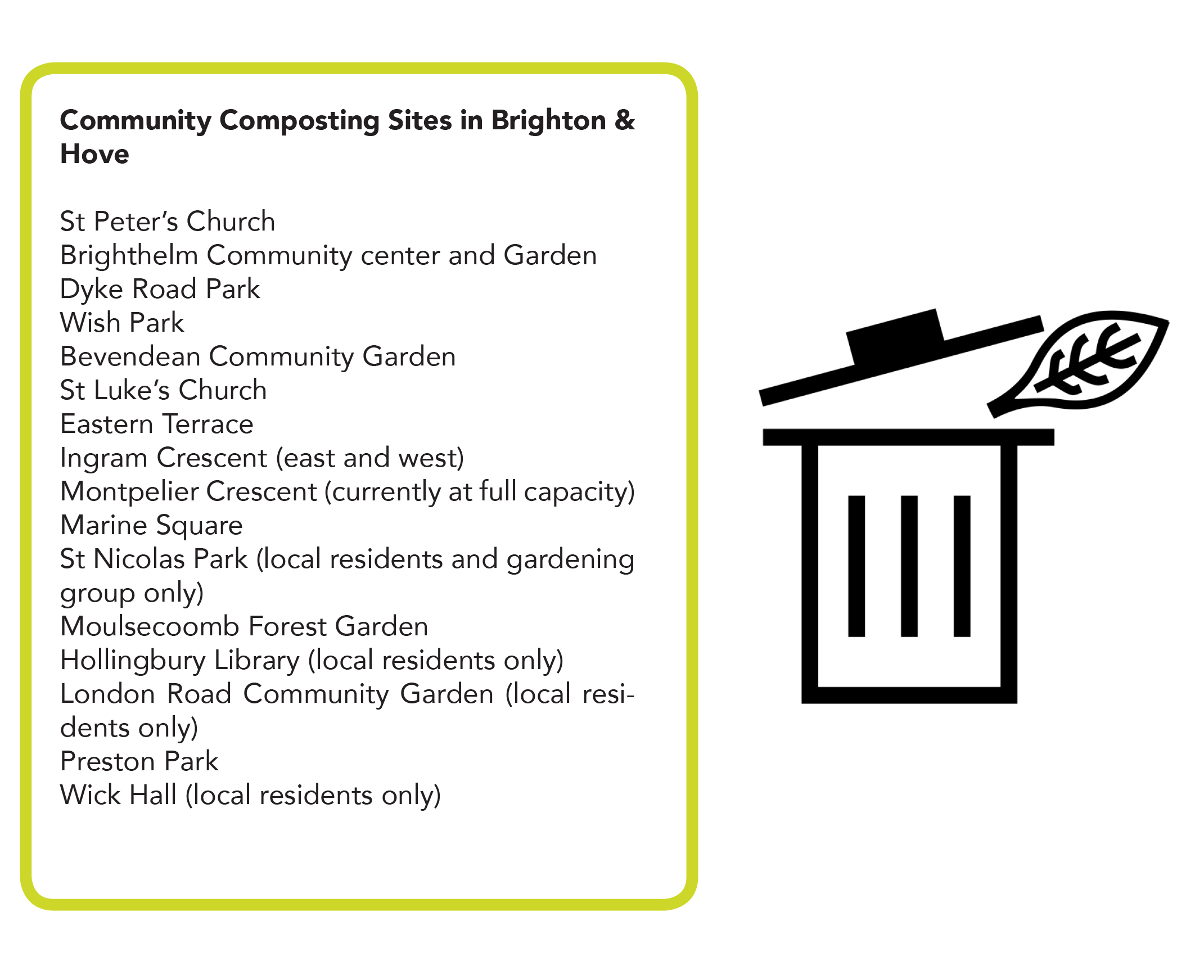
Although there is currently no food waste collection by Brighton and Hove City Council, they are aiming to help reduce food waste by working with The Brighton and Hove food Partnership organisation to set up community composting around the city. They have already set up 16 community composting sites, as listed below. In addition to this, The Brighton and Hove Food Partnership alongside the council are on track to set up a community fridge, funded by Sainsburys. This will allow local residents to leave any spare food for hungry people and again help reduce food waste around the city.
Having reviewed these areas of recycling around Brighton and Hove, you could argue that although the statistics for household recycling may not seem very high, there is without a doubt a sense of community ownership of recycling which is not quantified in these statistics. The council decided, only a few days ago, to phase out the use of single-use plastics in the city. This motion was supported by a public petition, proving that the people of Brighton & Hove take it upon themselves, with the help of private and public organisations, to find creative ways of cutting down, re-using and recycling waste in the city.
So perhaps the fact that we have a lack of recycling resources available on our doorstep doesn't matter as much when there are efforts in place to cut down on the production of waste in the first place.
There is that old saying that 'prevention is better than cure' after all.
We are going to start talking a lot more about designing out waste.
How to build the marketing strategy for your eco business

Promoting a brand, product or service with limited marketing resources is a difficult challenge. We've been working with the University of Brighton's Green Growth Platform for the past few years, hosting regular free workshops to their members, to help give them the tools to execute a great marketing campaign on a low budget.
One practice that we use to put together a marketing strategy for all of our clients, as well as advise in our workshops, is "POST".
What goes into a POST marketing plan?

P | People
Who are you trying to target?
Every successful business is centered around solving a pain point for people. However, in order to reach the people with the pain, you need to know who they are and how you can reach them.
When we talk about ‘people’ at the start of a strategy, what we’re really doing in “official marketing terms” is creating different ‘audience segments’.
The more detail you can go into on who you’re trying to target, the more creative you can get with the messaging - and the lower the risk of alienating people.
The most effective marketing strategies identify and target between 3 and 5 different ‘personas’, painting a picture of them with the following types of data:
Age
Gender
Location
Occupation
Routine (specifically relationship commitments and work patterns)
Buying habits (what they choose to spend their money on)
Views (political, sociological and other topics important to them)

O | Objective
What are you trying to achieve?
'Marketing' is an open ended practice. There are so many different ways that a product, service or brand can be marketed, but the most ineffective campaigns are those who spread their efforts too thinly.
This is where separating your marketing efforts by campaign objectives is vital. Firstly, it enables you to keep your "eyes of the prize" through the campaign, but it also acts as a pinnacle through the strategy planning stages to help you keep on mission.
And you need to be specific: How many more sales do you want? How much higher would you like your reach or engagement to be? How many more site visitors or social media followers do you want?

S | Strategy
How are you going to achieve it?
This is when you start really getting into the creative thinking through identifying the messages that would both speak to your audience and help you to meet your objective.
The best marketing plans include a range of different ways that you can do this.
Examples of strategies that would be implemented include educating the audience on your industry, directly selling your product, highlighting certain aspects of your product, and building or supporting a community to promote brand awareness.

T | Tactics
Which tools will you use?
Here's where you get into the details and map out which platforms you're going to use for getting these messages out there - with a big focus on where your target audience are.
For instance, if you're trying to promote discounts to certain organisations, it can be most effective to flyer outside of their building. Alternatively, if you're trying to sell a type of food to families across the UK, Google display ads would be better practice.
You can use a range of different tactics per strategy.
Or you can contact us and we can run them for your business

4 things to consider with Local Search Ranking
A snapshot guide into the four things everyone should be considering in their local search strategy.
Google is always changing and keeping up with them can be hard.
However, over the past few years they have become much more transparent, particularly with regards to SEO.
Drawing from the sources on the highly respectable blog, Search Engine Watch, Google recently ‘hinted’ at the ways it determines your local business ranking. Now, knowing what we know from Andrey Lipattsev (the Search Quality Senior Strategist at Google Ireland) about the importance of ‘content’ and ‘links’ in general search engine optimising, it is no coincidence that the key ideas for optimising local search are very similar.
We've broken this down into four points
1. Relevance
How relevant is your local listing and how much of the content will match what your local customers could be typing into Google? This is where detail, keen marketing strategy and good copy play a key role in the optimising of your business. Make sure the content of your company’s information sections are rich, detailed and extensive. Don’t be afraid to be explicit with every facet of your organisation.
2. Distance
How close you are to the customer searching for your service? This one is quite simple really, and not much can be done to change your location, just make sure all your location details are up to date. Remember, relevance is a ‘stronger’ ranking factor; Google would rather put a business with better, more relevant services, higher on their local rankings than a business that is closer.
3. Prominence
This is the interesting information. Essentially, this translates to how well known your business is in the ‘offline world’. Google collates all manner of information they have on your business from a range of sources. Predominately, they consider links and articles concerning your company and positive reviews online. This means SEO best practices apply, as well as prompting customers to review favourably. Which leads us on to…
Customer Reviews and Google My Business
We now know that customer reviews are of serious importance to your local search ranking. Thus, logic follows that Google reviews and Google My Business information sections are of equal importance, if not more. Make sure to have complete Google My Business and Google + accounts, and prompt all your customers to leave Google reviews.
In short, the devil is in the detail. You can never have too much information surrounding your company. Combine that with SEO best practices and keen market research, and you have the best way to improve your local search rankings.

A marketer's introduction to Micro-Moments
We've put together a short guide explaining the marketing phenomenon, 'Micro Moments'.
Over the past few months, Google have published extensive research and articles on the market phenomena known as ‘Micro-Moments’, and their importance in brand awareness.
We've put together a short guide to give you a better understanding of their research.
What is a Micro-Moment?
Google says they are, “critical touch points within today’s consumer journey, and when added together, they ultimately determine how that journey ends.”
To be less cryptic, these are the ‘I want to know, I want to do/buy, where is the nearest’ questions that are often typed into Google whilst on the move, or before the beginning of a journey towards ‘something’ (hopefully your product!).
As you might expect, Google highlight the use of mobile devices as a key indicator of search behaviours that illustrate these ‘Micro-Moments’.
According to Search Engine Watch, Google published these findings, which are probably a good indicator of a wider mobile global market:
· 91% of smartphone users turn to their phones for ideas when in the middle of a task.
· 90% are not certain of the brand they want to buy from.
· 82% use their phones to check on prospective in-store purchases.
· 65% look for the most relevant information to their query, regardless of the company that provides the answer.
· 51% have discovered a new company or product when searching on their phone.
· 33% have purchased from a different brand than the one they had in mind, because of the information provided.
With these kind of findings, marketing and SEO becomes slightly more complex, but the opportunities are vast. The ‘mobile search land’ is still anyone’s game, open for everyone to claim a nice section of local brand dominance.
This is where you should make your mark!
Now, it is important to consider two key points about the mobile market; the users are very active and not remotely brand loyal, yet.
STRATEGIES
The ‘near me’ search: this first idea will overshadow the other three approaches because Google have made clear that searches involving phrases like, ‘near me or nearby’ have doubled in the past year alone.
Check out our post on how to optimise for me ‘near me’ searches.
Anticipation: know what your customers and, most importantly, your prospective customers are going to ask for as a part of your industry before they do. Understanding your customer’s profiles is of grave importance if you are going to be successfully aligning your services with your consumers’ needs.
This kind of insight could be very useful to value driven businesses that want to expand their customer base and get the word out faster!
Relevance: if you have managed to tap into the psyche of your clientele, you have really accomplished half the battle. However, in order to keep them, you must offer the clearest and most relevant information possible. Understand that what one client might need in that ‘Micro-Moment’ might not be the full extent of what they are asking for.
As an expert in your industry you probably already know this, but it is your job to accompany them through that process of understanding and change.
Speed: this is probably the trickiest part, and probably why anticipation is so important in this strategic equation. It is important that this kind of interaction with customers is fast; the new generation of mobile users do not have the time to wait because they can go elsewhere with the click of a button.

How to make the most of 'Near Me' search in Local SEO
A guide to using 'near me' search to help your local business get found.
In the last 5 years the ‘near me’ search has exploded in the world of search engine terms.
What is it?
The ‘near me’ search term is pretty self-explanatory; it is anything typed into a search engine that contains the phrases, ‘near me’, ‘nearby’ or ‘nearest’ etc.
Reportedly, since 2013 the ‘near me’ search term has grown almost 15-fold, with the terms doubling in the last year alone. So the question presents itself, how do you optimise for ‘near me’ searches?
SEO BEST PRACTICES
Make your website code clean, technically optimised, and designed so it is easily navigable and the user experience is rewarding. Get all your content to be appealing and optimised for search engines, and social media.
ONLINE BUSINESS INFORMATION
Google sources information about your company from around the web, to place in their local business listings. So, make it all a little easier from them. Be sure to have up to date contact information, an embedded map (a Google map is always good), opening hours, name of contact, company email addresses, customer reviews etc. Search Engine Watch recommends a ‘schema markup’ for extra ‘brownie points’.
LOCAL BUSINESS LISTINGS
Signing up to relevant directories online can be very helpful, as is the Moz Local resource. However, be careful, Google considers most directories spam.
SOCIAL PROOF
This is a funny little phenomenon that garners serious clout in the world of today’s increasingly cynical online users.
One of the biggest avenues to spread the word is Social Media!
One Search Engine blogger described it as a restaurant in Disneyland Florida. To be brief, if you saw a restaurant in a crowded place that was empty, you might assume that the food was rather bad (or something health related had gone awry there), either way, you would probably follow the crowd to the other restaurants that looked ‘good’ i.e. had more people frequenting it.
Your website is no different, don’t forget to gather positive testimonials, ratings, reviews, Google Reviews, endorsements from the right sources and logos from affiliates to give your web presence credibility in your local area.
SOCIAL MEDIa
High social media stats play a role in this idea of online efficacy, from your connections to your shares; the online community will judge you based on your Facebook, Twitter, Instagram and Pinterest rankings. Although this doesn’t link directly to the ‘near me’ search term, the importance of this in Local SEO and the overall effects for your business is detrimental.
Communicating with the new digital generation is key!
LINK LOCALLY
Reach out to local businesses and make connections with them online. Anything goes: events, awards, schools, non-competing companies and maybe even your competitors.
It’s about being a community.
THE NEAR ME COPY
Now, for the most obvious part, adding the phrase ‘near me’, ‘nearby’ or ‘nearest’ to you website’s content. It works so don’t forget it.